
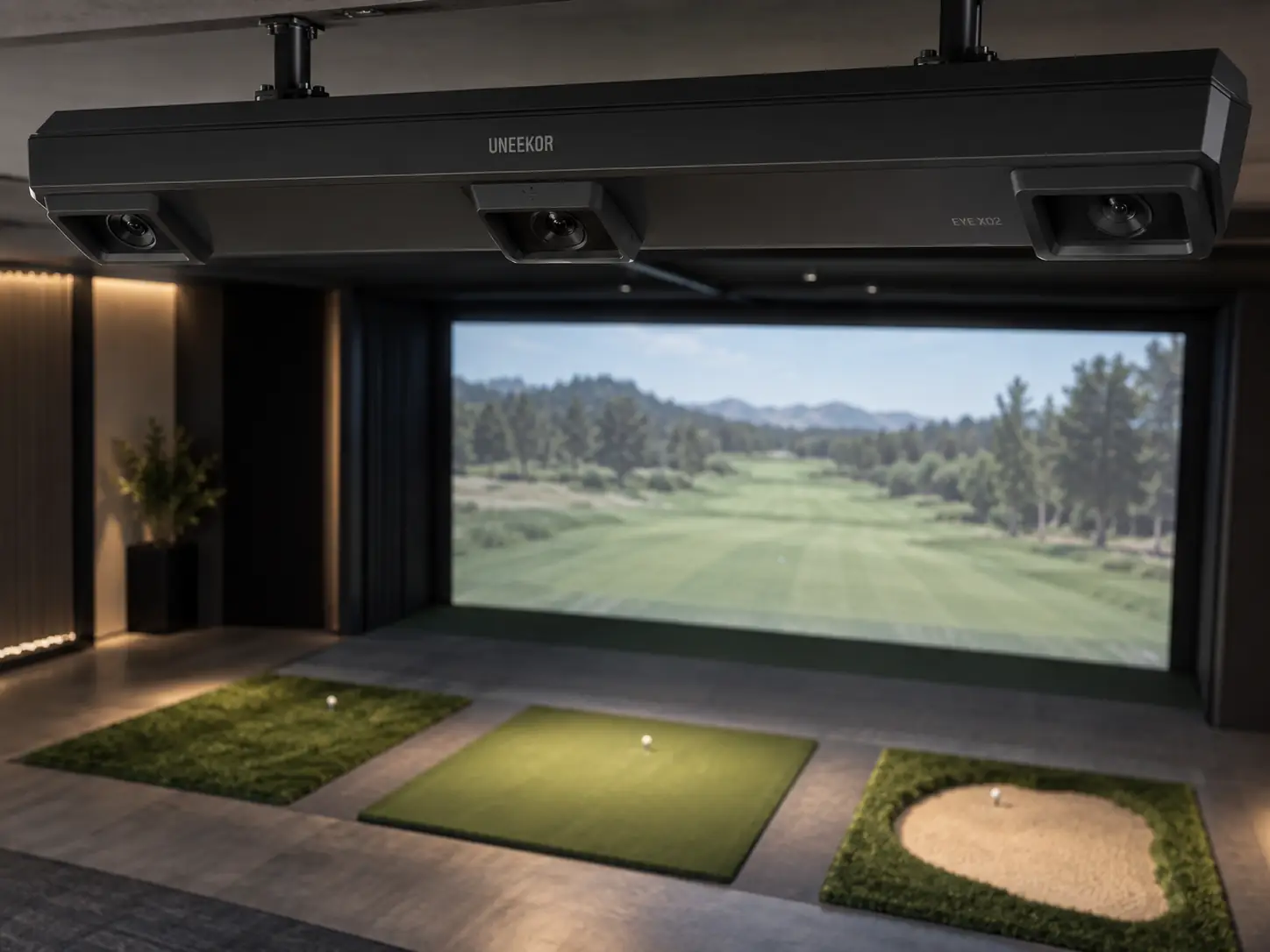
The Uneekor EYE XO2 is worth its premium when a simulator needs more usable hitting area, smoother player changes, or rough and bunker practice.
Its third camera creates a twenty-eight-by-twenty-one-inch hitting zone that is much larger than the area covered by EYE XO.
It does not publish more metrics than EYE XO, and the available evidence does not prove that a centered shot becomes more accurate.
At the current $10,999 price, the Uneekor EYE XO2 launch monitor costs $4,500 more than EYE XO.
That premium makes sense only when the wider working area changes how the bay is used.
The Premium Buys Capacity Rather Than Another Data Tier
EYE XO2 is a fixed front-overhead launch monitor with three high-speed cameras.
It reads ordinary golf balls, captures a prepared club through impact, and leaves the floor clear for either handedness.
The software reports twenty-four ball, flight, and club values.
Those are the same published fields provided by EYE XO.
The extra camera expands the area the system can watch, but it does not add another club metric.
That distinction is important because the spec sheet alone makes the $4,500 difference hard to explain.
The value appears when several golfers use different ball positions, a coach changes the task frequently, or the room includes more than one hitting surface.
One careful owner can learn a smaller hitting rectangle quickly.
A child, guest, lesson student, or league player may move the ball on every club change.
EYE XO2 gives those players more room to be natural without stopping the session for constant corrections.
The Wider Zone Changes How People Use The Bay
The twenty-eight-by-twenty-one-inch zone is the defining EYE XO2 feature.
EYE XO covers roughly twelve by sixteen inches.
That difference gives you more freedom to vary tee position and place more than one hitting texture inside the calibrated area.
The wider zone can improve several real workflows:
- right- and left-handed golfers can address the ball naturally without moving the monitor
- students and guests have a larger valid area for ball placement
- coaches can change setup or drill location without constant re-centering
- facilities can reduce pauses between players and clubs
- standard turf and Trouble Mat pieces can share the active area
More coverage does not remove the need for alignment.
The ball still has to remain inside the calibrated zone, and the cameras need an unobstructed view.
A large capture area also does not make a narrow or shallow room safe.
The golfer, screen, enclosure, projector, and ceiling still decide whether the complete simulator fits.
Trouble Mat Makes The Extra Coverage Tangible
Trouble Mat support gives the larger zone a clear job beyond easier ball placement.
Uneekor provides rough and bunker-style inserts that can sit inside the calibrated area.
Instead of letting software apply a lie penalty while you continue hitting from perfect turf, the physical surface changes the way the club reaches the ball.
Rough fibers can interfere with the club.
The bunker-style insert changes how the sole moves through impact.
It is still a simulation.
A small synthetic insert cannot reproduce every sand depth, moisture level, slope, or type of grass found outdoors.
Its value is making the strike task less uniform and giving you another practice condition inside the same room.
The current manual recommends a suitable base mat around one and a half inches thick for proper support.
Confirm the exact Trouble Mat pieces and bundle shown at checkout because included accessories and promotions can change.
Club Analysis Remains Dependent On Stickers
EYE XO2 provides nine documented club fields when the clubface is prepared correctly.
The set begins with speed and strike efficiency, then adds path, face, attack, loft, delivered lie, and impact location.
Together, those numbers connect the ball result with delivery and contact.
Club Optix also provides an impact image that can make the data easier to understand.
The ball does not need a printed pattern.
The club still needs Uneekor’s bar-and-dot stickers for the complete interpreted club-data experience.
That may be a one-time setup job for a private golfer using one set.
A public studio or fitting room needs a process for customer clubs, demo heads, worn stickers, and reflective finishes.
The large hitting zone does not remove that maintenance.
I would choose EYE XR instead when sticker-free operation matters more than the five advanced club fields its manual does not list.
A Thirty-Pound Ceiling Unit Needs A Real Installation
EYE XO2 is roughly thirty-six inches wide and weighs about thirty pounds.
This is not a sensor you casually attach to drywall with a few general-purpose anchors.
Uneekor recommends at least two people for mounting and warns that the bracket needs suitable structure.
The center of the unit belongs about three feet six inches in front of the hitting position.
The downward-facing camera plane needs a height between nine and ten feet over the hitting surface.
Uneekor’s current general room recommendation is about thirteen feet wide, sixteen feet deep, and ten feet high.
Treat those measurements as a planning start, not a guarantee.
A tall golfer, long driver, deep enclosure, projector, ceiling beam, or nearby wall may require more space.
The unit uses separate power and Ethernet connections.
The data cable should run directly to the PC’s onboard network port, with Wi-Fi or another adapter handling internet access.
I would confirm reliable ball and club capture before hiding the cables or closing any ceiling work.
If the monitor, mat, hitting insert, Trouble Mat position, or turf height changes, recalibrate.
The Accuracy Case Must Stay Within The Evidence
Uneekor does not publish a universal tolerance for every EYE XO2 value.
Independent reviews have reported close agreement with premium reference systems, but the public tests do not provide complete reproducible paired-shot data.
One attempted comparison with ProTee VX could not record the same swing on both units because the infrared systems interfered with each other.
That makes it impossible to use those separate samples as proof that one monitor was closer to the truth.
The third camera clearly supports the larger observed region.
It is reasonable to expect fewer placement-related problems when more of the mat sits inside that region.
It is not reasonable to turn that benefit into a promise that a centered shot is inherently more accurate than the same shot on EYE XO.
Sticker condition, extreme loft, club finish, obstruction, sensor height, moved turf, network problems, and stale calibration can all affect capture.
I would judge consistency after the installation is correct before changing a golf swing around one strange number.
Software And Computing Add Operating Cost
EYE XO2 requires a Windows gaming PC and Uneekor software for every session.
There is no battery, built-in screen, native Mac workflow, or outdoor role.
The computer requirement depends on the simulator you are building.
Basic VIEW practice is much lighter than 4K course play, multiple swing cameras, or AI Trainer.
The free Player level handles essential data, one golfer profile, a practice range, and a modest number of saved reports.
Pro currently costs $199 a year.
Its main additions are outside-software connection, four more profiles, higher report limits, and five Refine courses.
GSPro, E6 Connect, TGC 2019, Creative Golf, and ProTee Play require their own licenses.
I would budget the system in three layers:
- the PC, projector, and display hardware determine visual performance
- the Uneekor membership determines native tools and connector access
- the separate simulator license determines outside courses and game modes
Higher plans can add AI tools, online play, and larger profile allowances.
A teaching or commercial room should also confirm commercial software rights in writing.
Calculate The Bay-Traffic Premium
The $4,500 difference from EYE XO is easier to judge as an operating cost.
Start by counting how many people use different natural ball positions each week.
Then count lessons, family sessions, league rotations, or paid bookings with frequent changeovers.
Decide how often rough and bunker practice will actually be selected.
Estimate how much time a smaller zone would spend on placement corrections and interrupted setup.
Finally, decide whether smoother sessions improve household use, teaching quality, or paid capacity enough to matter over several years.
A private golfer hitting from one insert may save almost no meaningful time.
A busy studio can accumulate hundreds of small interruptions.
That is where the larger zone becomes an operational feature rather than an expensive rectangle on a specification sheet.
EYE XO And EYE XR Reveal The Buyer Fit
EYE XO offers the same twenty-four published fields for $4,500 less.
It is the stronger choice when one golfer or coach can keep the ball inside a twelve-by-sixteen-inch area.
EYE XR costs less again, mounts behind the golfer, and removes club stickers.
Its model-specific manual lists only four club fields, so it favors convenience over detailed delivery analysis.
Compare the full Uneekor golf simulator collection only after measuring the ceiling, because its floor-mounted choices solve rooms that cannot carry this sensor.
I would compare models only after deciding which of three things matters most: analytical depth, sticker-free operation, or active hitting area.
That prevents the flagship label from making the decision for you.
EYE XO2 Is Built For A Bay That Stays Busy
EYE XO2 earns its place through bay traffic, not a longer list of measured fields.
A single golfer on one insert should keep the $4,500 difference and choose EYE XO.
A golfer who values sticker-free clubs more than deep delivery data should start with EYE XR.
XO2 becomes the sensible flagship only when a wider active area and physical trouble lies remove recurring friction from a busy week.
What did you think?
Tap a reaction — no need to write anything.
Thanks for letting us know!
Interested in this?
Leave your details and tell us which applies.

Comments are closed.