
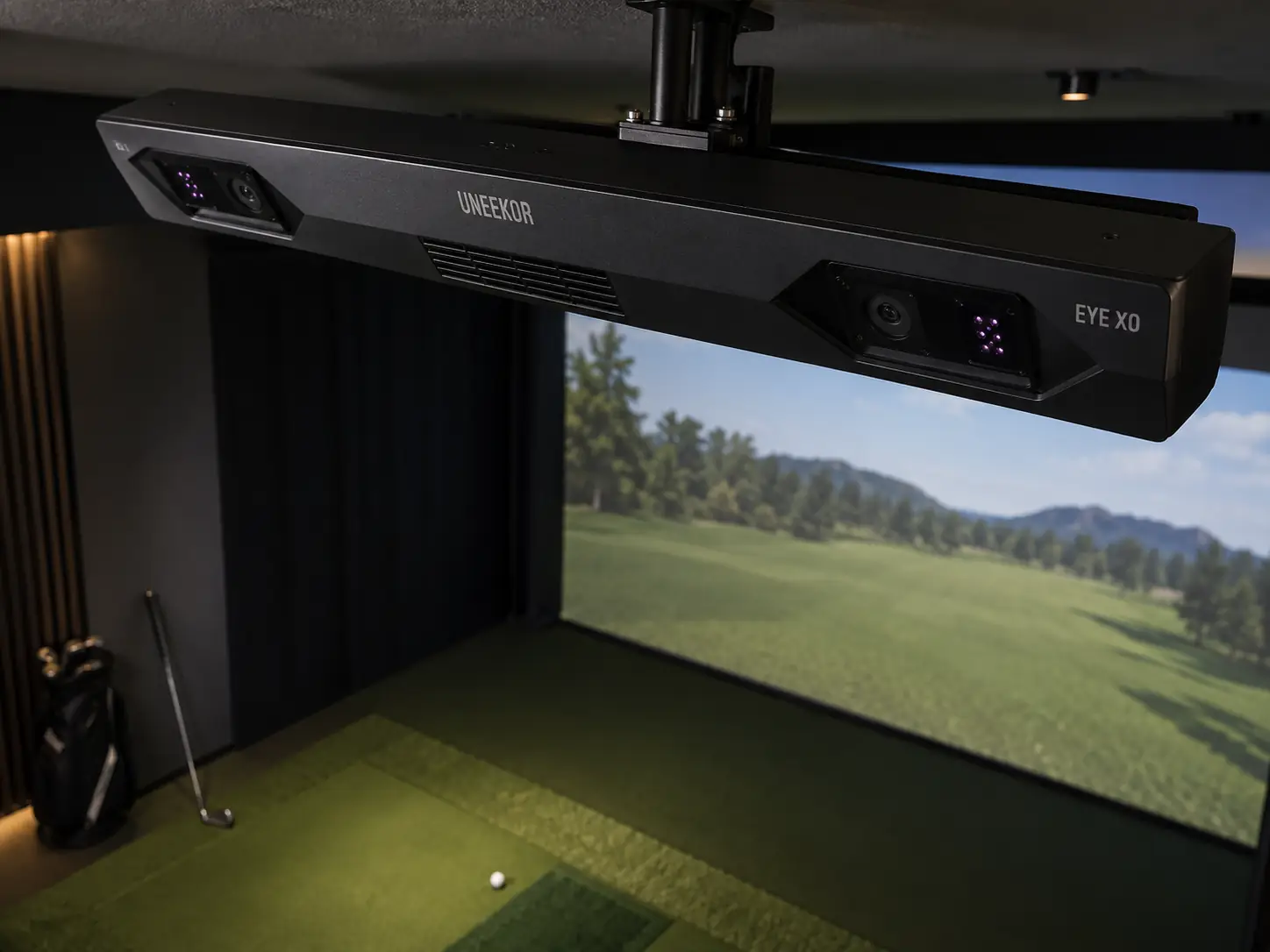
The Uneekor EYE XO is the overhead model I would choose when detailed club delivery matters more than sticker-free convenience or a very large hitting zone.
It reports the same twenty-four ball, flight, and club fields as EYE XO2 for much less money.
At the current $6,499 price, it is also only $500 above EYE XR.
The tradeoffs are a smaller hitting area, front mounting, and reflective stickers for the complete club-data experience.
That makes the Uneekor EYE XO launch monitor an unusually strong value for serious practice, coaching, and fitting.
Full Club Data Is The Reason To Buy EYE XO
The nine documented club fields are the reason to buy EYE XO.
Two high-speed cameras mount to the ceiling in front of the golfer.
They watch the ball and prepared club through impact while leaving the floor open for either handedness.
The full software set includes fifteen ball and modeled-flight values plus nine club values.
Ball speed, launch, spin, carry, total distance, peak height, descent, and lateral result describe what the shot did.
Club speed, smash factor, path, face angle, face-to-path, attack angle, dynamic loft, delivered lie, and impact point help explain why.
A golfer mainly playing simulated rounds may not use every one of those fields.
A coach changing delivery, a fitter comparing equipment, or a player rebuilding impact can use them in almost every session.
EYE XO is at its best when those extra numbers lead to a different practice decision.
If they will only fill another column on the screen, EYE XR may provide the cleaner experience.
The Stickers Trade Convenience For Interpretation
EYE XO works with an ordinary clean white golf ball.
You do not need the marked balls required by Uneekor’s older QED system.
The club is different.
Uneekor’s current model page and support material require reflective stickers for complete and accurate club data.
The bar-and-dot pattern gives the cameras a reliable reference for the clubface.
Once a normal set is prepared, the stickers can become a minor part of the routine.
A fitting studio has more work because new heads and customer clubs enter the bay constantly.
Worn, missing, reflective, or badly positioned stickers can also weaken the data that justifies the monitor.
I would not buy EYE XO while planning to ignore the sticker process.
Ball data will still be useful, but the full club package is what separates this model from less expensive options.
If sticker-free play is non-negotiable, EYE XR is the more coherent choice.
Nine Club Fields Support Different Decisions
The nine club fields become easier to understand when you group them by the problem they solve.
- club speed and smash factor show how efficiently speed turns into ball speed
- path, face angle, and face-to-path help explain start direction and curve
- attack angle, dynamic loft, and lie describe delivery into the ball
- impact point shows where contact occurred across the clubface
Those groups can separate problems that look similar in ball flight.
A low launch could come from delivered loft, strike location, club speed, or a combination of factors.
A curve can be studied through the face and path relationship instead of guessed from the final screen image.
Some values are calculated relationships rather than separate camera observations.
Smash factor compares ball speed with club speed, and face-to-path compares two directional values.
Carry, run, and total distance also depend on a flight model because the real ball only travels to the screen.
That does not make the information less useful.
It means you should know which number was observed, which was calculated, and what question it helps answer.
Front Mounting Needs Protection And Precision
EYE XO mounts about three feet six inches in front of the center of the hitting zone.
The sensors need to sit between nine and ten feet above the hitting surface.
The documented capture area is approximately twelve inches wide by sixteen inches long.
Uneekor currently suggests a room around thirteen feet wide, sixteen feet deep, and ten feet high as a general starting point.
That is not a promise that every golfer can swing safely in those dimensions.
Driver length, player height, screen distance, enclosure depth, projector position, and nearby walls all matter.
Front mounting also puts the sensor closer to the direction of a badly popped-up ball.
The enclosure and ceiling protection should control that risk.
Uneekor now provides limited strike coverage for new EYE XO and EYE XO2 sensors, but I would not use warranty language as a substitute for physical protection.
If the mat, hitting insert, or sensor moves, recalibrate.
A ceiling position that looks close enough can still create no-reads when the height, angle, or target-line relationship is wrong.
Two Cables And A Windows PC Run The System
EYE XO uses separate power and Ethernet connections.
The network cable should run directly to the computer’s onboard Ethernet port.
A second network interface or Wi-Fi can handle internet access while the launch monitor keeps its dedicated wired link.
I would install the system in this order:
- Verify ceiling structure, golfer clearance, screen protection, and the exact sensor position.
- Mount the unit level and square to the target line.
- Connect power and Ethernet before adding other simulator equipment.
- Install Uneekor Launcher, register the unit, and complete calibration.
- Confirm repeatable ball and club reads before hiding cables.
The monitor has no battery, onboard display, or native tablet mode.
A Windows gaming PC is part of every session.
The computer you need depends on the projector resolution, simulator software, swing cameras, and whether you plan to use AI Trainer.
Uneekor’s present recommendations demand considerably more computer power than several older retailer specification blocks suggest.
Build for the finished simulator rather than the simplest practice screen.
Accuracy Evidence Is Useful But Not Absolute
Uneekor does not publish one universal accuracy tolerance for every EYE XO metric.
Independent evidence is still useful when its limits remain clear.
One Carl’s Place exercise compared sixty outdoor shots with observed landing locations.
Another Garage Golf project compared seventy-five shots with GCQuad results across several sessions.
Both reported broadly credible performance.
Neither test proves that every number will always fall within a fixed percentage or distance.
The outdoor exercise used range balls, weather, terrain, and human estimates of where shots landed.
The GCQuad project did not publish a complete simultaneous paired-shot raw data set that another tester could reproduce.
My conclusion is straightforward.
EYE XO has useful independent evidence and a long enough history to be taken seriously.
Correct installation, calibration, sticker condition, and ball position still affect the quality of the results.
Software Choice Changes The Annual Cost
The free Player membership covers core data, a virtual practice range, one profile, and limited reports.
The current Pro membership costs $199 per year.
That subscription opens connector access and increases the profile, report, and Refine allowances.
Current compatible options named by Uneekor include GSPro, E6 Connect, TGC 2019, Creative Golf, and ProTee Play.
Each program is sold separately.
That means a GSPro build needs the Uneekor connector plan, the GSPro license, and a suitable Windows gaming PC.
Higher Uneekor plans add AI Trainer, more course content, online play, and larger profile allowances.
Some of those tools also need swing cameras or a second display.
I would base the budget on normal renewal pricing, not a temporary first-year software offer.
The sensor, computer, projector, screen, enclosure, mat, cables, mount, and software all belong in the same total.
Audit The Five Advanced Fields Before Paying
The easiest way to compare EYE XO with EYE XR is to audit the five advanced fields XR’s manual does not list.
Ask whether attack angle will change how you train upward or downward delivery.
Ask whether dynamic loft will help explain launch and spin.
Ask whether face-to-path will make curvature work clearer.
Ask whether delivered lie matters to the coaching or fitting work being done.
Ask whether numerical impact location will be used alongside the impact image.
If none of those answers is yes, sticker-free EYE XR may be the better purchase.
If several of them will be used every week, EYE XO’s current $500 premium is easy to defend.
This is more useful than comparing the headline number of metrics.
You are paying for decisions the extra fields allow you to make.
XO2 Buys Working Area Rather Than More Metrics
EYE XO2 reports the same twenty-four fields as EYE XO.
Its higher price pays mainly for a third camera, a twenty-eight-by-twenty-one-inch hitting zone, and Trouble Mat support.
Those features can help a family, coach, league, or commercial operator with frequent player changes and varied ball positions.
A disciplined golfer hitting from one insert may gain very little from the extra area.
In that room, EYE XO provides the same published analytics for $4,500 less.
A busy facility may reach the opposite conclusion because fewer placement corrections improve the flow of every session.
The Uneekor golf simulator range also includes rear-mounted and floor-based options.
Compare them after deciding whether complete club delivery, sticker-free operation, or a wider active area matters most.
EYE XO Remains The Analytical Value Point
EYE XO is still the analytical value point in Uneekor’s overhead range.
It gives a serious golfer, coach, or fitter the full documented club package without charging for XO2’s larger working area.
I would choose it when the room supports precise front mounting and the clubs can stay stickered.
I would choose EYE XR when clean, sticker-free shared play matters more than the five advanced fields.
I would choose EYE XO2 when the bigger zone and Trouble Mat will improve a busy bay every week.
EYE XO is not the newest or largest model.
It is the one that makes the most sense when detailed club delivery is the reason you are buying an overhead monitor.
What did you think?
Tap a reaction — no need to write anything.
Thanks for letting us know!
Interested in this?
Leave your details and tell us which applies.

Comments are closed.