
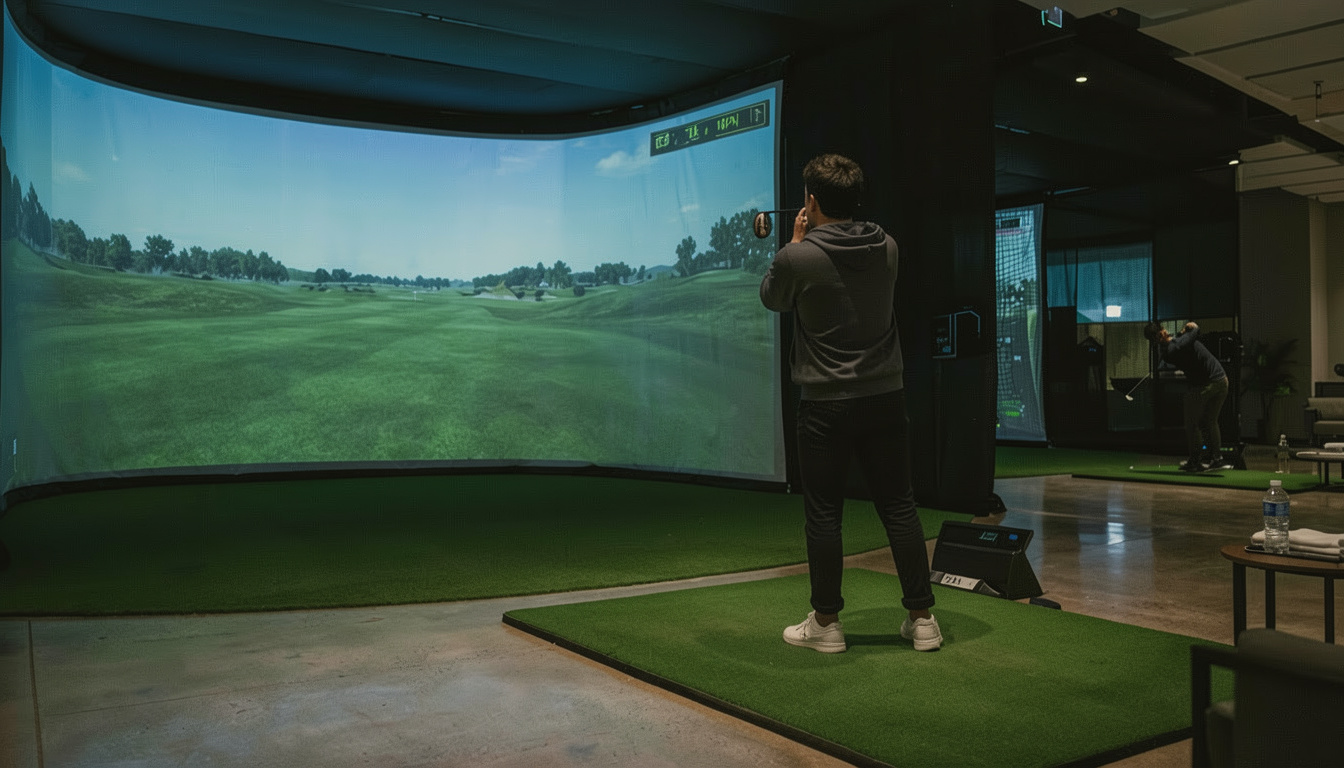
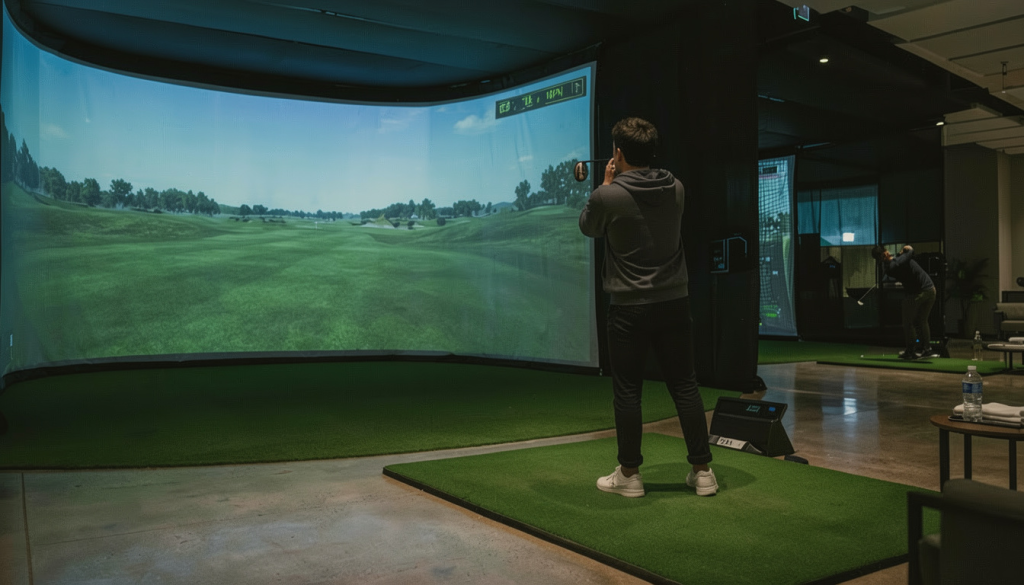
Picture this. It’s 11:40 at night. You just left a work dinner that ran long, you are still wound up, and every driving range within twenty miles has been dark for hours. A few years ago that would have been the end of your golf day. Now you pull up an app, tap a bay that’s free at your local simulator lounge, punch in a door code, and you are hitting balls at midnight with absolutely nobody there to stop you. No front desk. No “sorry, we close at nine.” Just you, a launch monitor, and however many buckets of range balls your patience can handle.
That scene is becoming completely normal, and it’s happening faster than almost anyone in the indoor golf world expected. The unmanned, 24/7 simulator bay is having a real moment, and once you see why it works, it’s honestly hard to imagine the old staffed model competing with it for very long in this particular niche.
What “Unmanned” Actually Means Here
Let’s get the terminology straight first, because “unmanned” sounds a little more sci-fi than it actually is. Nobody is installing robots that hand you a 7-iron. What it actually means is a facility that runs without a staffed front desk. You book your bay ahead of time through an app, you show up whenever your reservation starts, and a smart lock or a QR code lets you into the building and into your specific bay. The simulator itself powers on automatically when your session begins, a camera or two keeps an eye on things for security, and if something goes wrong there’s usually an in-app chat or an intercom line to a real human who is very much not on site.
It’s a genuinely clever piece of operational design once you think about it, because the two things that sink most small golf venues are the cost of labor and the fact that a building only earns money during the hours someone is standing behind the counter. Strip out the front desk and suddenly the same four bays can generate revenue at 2am on a Tuesday just as easily as at 6pm on a Saturday. The building never really closes, it just quietly keeps earning.
The Names Behind the Boom
If you’ve noticed one of these popping up in a strip mall near you lately, there’s a good chance it’s called Back Nine Golf, and the story behind that company is honestly a pretty good one. It was founded in St. George, Utah in 2020 by Wil Bangerter, who was a law student at BYU at the time. He was a self-described golf nut with basically no free time, and the only hours he could actually get on a simulator were late at night in the back of a warehouse. He built the business around the exact problem he had personally lived through, which I think explains a lot about why the concept resonates so well with people.
The growth since then has been, frankly, kind of stunning. As of this year Back Nine has expanded to more than 300 operating locations across dozens of states, and the company has sold over 600 franchise territories across the US, Canada, the UK, Australia and New Zealand. They’re reportedly opening somewhere between 15 and 20 new franchise locations every single month. That is not a slow, cautious rollout. That is a company that found a formula and is stamping it out about as fast as construction crews can build it. Back Nine locations run on Full Swing simulators, which is worth noting because Full Swing is also the official simulator technology partner of TGL, the primetime team golf league backed by Tiger Woods and Rory McIlroy, so there’s a nice halo effect of legitimacy that comes with the hardware.
Back Nine isn’t alone out here either. Another Nine just closed its first full year of franchising with more than 80 territories awarded across 16 states and 33 owners signed, and the company is expecting somewhere between 15 and 20 locations open by the end of this year, running on TrackMan gameplay for its 24/7 self-serve concept. Then there’s The Golf Crypt, a members-only Trackman club that started in Jupiter, Florida and has since been named a Trackman preferred franchise partner, which is not a designation the company hands out casually. Golf Crypt members get 24/7 access through a secure entry system, and the whole model is built on the idea that a private, unstaffed space is actually more appealing to a lot of golfers than a crowded, staffed one, not less.
Why the Economics Work So Well
Here’s the part that I find genuinely interesting, because it’s not just a lifestyle trend, it’s a legitimately smart business model. Labor is the single largest recurring cost for almost any indoor golf venue, full stop. A staffed lounge needs someone behind the counter checking people in, handling payments, dealing with technical hiccups, and generally being present for every open hour, which for a place trying to compete on convenience might mean paying for a 14 or 16 hour staffed day. Strip that out and your costs collapse down to rent, utilities, insurance and whatever you’re paying for the booking and access-control software. Everything else becomes close to pure margin.
The membership pricing tells the story pretty clearly too. Take a recent Back Nine build-out in Roseville, California, where the franchise owner described three membership tiers running roughly $179 to $359 a month, each tier buying you a longer daily tee-time window, along with guest passes and tournament discounts that scale up the ladder. Members book their tee times online and let themselves in with a QR code, no staff required to open the door, ever. Multiply a membership base like that across a four-bay location running 24 hours a day, and you start to see why franchisees are lining up. The Golf Crypt runs a similar tiered model, starting around $149 a month for three hours of play and scaling up to roughly $489 a month for twenty hours, with an hourly overage rate on top for anyone who blows past their allotment (which, if you’re anything like me and get a little obsessive once you start seeing your numbers improve, happens more often than you’d think).
On the hardware side, a single commercial simulator bay is not cheap. Full Swing units for a build like this are commonly estimated in the $30,000 to $60,000 range per bay once you include the projector, computer, screen and installation, and some reporting on individual franchise builds has cited numbers around $60,000 in hardware alone for a single bay. That’s real money going into the ground before a single membership dollar comes in. But once it’s installed, a bay that never has to close for the night pays that back a lot faster than one that only earns revenue for a handful of staffed hours a day.
The Real Draw: Time, Not Just Money
If you ask franchise owners why this format is catching on, the answer that keeps coming up isn’t really about the money at all, it’s about time. One Back Nine franchisee opening a location in Baltimore put it about as plainly as you can: playing a round for an hour before work, after work, or during a lunch break appeals to people who are similarly time-constrained, and corporate outings and team-building events are another obvious use case once you remove the constraint of business hours entirely.
That’s really the whole pitch in one sentence. Traditional golf has always fought against the clock, sunlight, weather, and a tee sheet that fills up on the one Saturday morning you actually have free. An unmanned simulator bay doesn’t care what time it is. It doesn’t care if it’s raining, or if it’s February in Illinois, or if the only gap in your schedule today happens to be 10:45pm. For a certain kind of golfer, the person who is busy, mildly obsessive, and doesn’t want their hobby dictating their calendar, that flexibility is worth more than almost anything else the facility could offer.
What Actually Enables This, Technically
None of this works without a fairly specific stack of technology quietly running in the background, and it’s worth understanding what’s actually doing the work here. Booking platforms built specifically for this model handle real-time bay availability, take payment up front, and issue a unique access credential, either a door code or an app-based QR pass, tied to that exact reservation window. When your session starts, the simulator itself is set to auto-power-on, and when your time is up, the system resets the bay and locks things down automatically for the next guest. Security cameras with remote monitoring cover the physical safety side, and most of these operations keep a live human reachable through in-app chat or an intercom for anyone who runs into trouble at 1am with nobody around to flag down in person.
It’s a genuinely elegant little ecosystem when it’s built right, and it’s also clearly still maturing. There’s active development happening around dedicated “facility operating system” style platforms meant to unify booking, automated simulator control, and access into a single stack, rather than operators duct-taping together separate vendors to make the unmanned model work. That tells me this corner of the industry still has standardization ahead of it, which is a good sign. The format isn’t done improving yet.
Not Just an American Thing
It’s worth zooming out for a second, because this isn’t purely a US phenomenon either, even if the American franchise names are the ones popping up in your neighborhood strip mall. In Shanghai, a chain called Golf Pod has built out more than 20 standardized, fully unmanned 24-hour indoor golf studios, with more in preparation and a stated goal of expanding to a hundred cities and a thousand stores. Similar unstaffed, membership-based venues have also taken root in Canada, with locations operating in both Toronto and Vancouver. The point is, this isn’t one scrappy American startup getting lucky, it’s a pattern showing up independently in multiple countries at roughly the same time, which usually means the underlying idea is just genuinely sound rather than a fluke of one particular market.
The Trade-offs Worth Knowing About
None of this is to say the unmanned model is strictly better in every way, because it isn’t, and it’s worth being honest about what you’re giving up. There’s no one on hand to fix a jammed ball tray or a glitching sensor at 11pm, so you’re leaning entirely on that in-app support line if something breaks mid-session. There’s no coach walking the floor to glance at your setup and casually fix a grip issue, the way there might be at a full-service, staffed teaching facility. And for some golfers, the social buzz of a bustling, staffed lounge with a bar and other groups around is actually part of the appeal of going out to hit balls in the first place, something an empty, quiet, unmanned bay at midnight simply can’t replicate.
But for the golfer who mostly wants reps, who wants to work on one swing thought for forty-five minutes without an audience, and who wants to do it on their own schedule rather than the facility’s, the trade-off is landing in favor of unmanned. The growth numbers make that hard to argue with.
Where This Is Headed
Given the pace of expansion right now, with hundreds of Back Nine locations already open and more opening at a rate of 15 to 20 a month, plus competitors like Another Nine and The Golf Crypt scaling their own territory counts, it’s a safe bet that an unmanned bay is going to be within a short drive of most suburban and even mid-size-city golfers within the next couple of years, if it isn’t already. Whether the pace holds depends on the usual things, franchise demand, execution on the ground, and broader economic conditions, but the underlying appeal, cheap-ish access to premium simulator technology on your own schedule with nobody hovering over your shoulder, doesn’t seem like the kind of thing that’s going away anytime soon.
So the next time you’re wide awake at midnight with a golf itch you can’t scratch, it’s worth checking whether one of these has quietly opened up near you. There’s a decent chance the answer is yes, and there’s an even better chance it wasn’t there a year ago.
What did you think?
Tap a reaction — no need to write anything.
Thanks for letting us know!
Interested in this?
Leave your details and tell us which applies.

Comments are closed.