
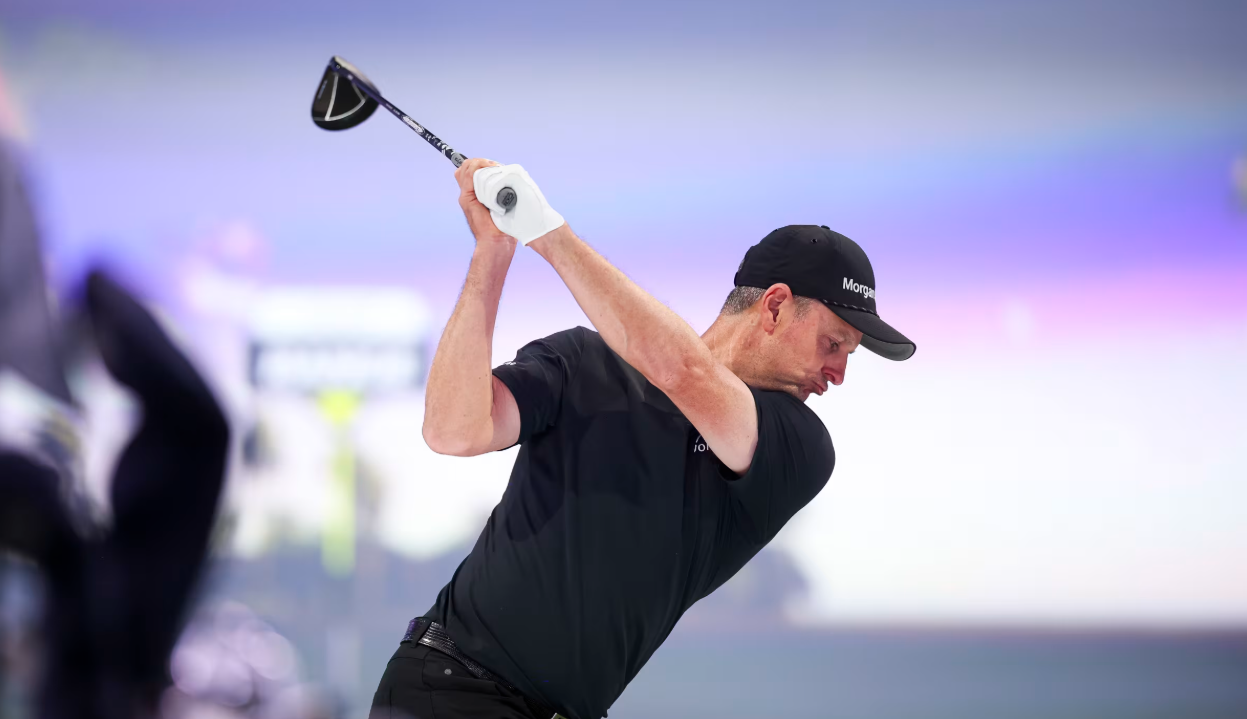
TGL was supposed to start in January 2024. Instead, golf fans had to wait another year to see what the new indoor league could actually do.
The delay came after a failure involving the temporary power and backup systems at the under-construction SoFi Center caused its air-supported dome to deflate in November 2023. The incident damaged part of the venue, although no one was injured and most of the technology was not affected. TGL ultimately pushed its launch to early 2025.
That extra time gave the league a chance to continue building and refining the experience before finally welcoming players and fans to SoFi Center.
When TGL arrived, it offered something golf had never quite seen before. PGA Tour players competed in teams, hitting shots into a giant virtual screen before moving on to a real, technology-driven short-game area. Matches were shorter, faster, and designed to bring more of the players’ personalities into the action.
Two seasons later, TGL has already produced dramatic comebacks, clutch putts, hole-in-ones, an albatross, overtime finishes, and two different champions.
Here’s a look back at how the league got started and some of the biggest moments from its first two seasons.
Season One: TGL Finally Takes the Stage
A new kind of golf makes its debut
After the long wait, TGL finally played its first match on January 7, 2025.
The concept was simple enough to understand but very different from traditional golf. Six teams competed throughout the season, with each team made up of four PGA TOUR players. Three players for each team competed in every match.
Instead of playing a traditional 18-hole round, TGL matches consisted of 15 holes. The first nine were played in Triples, where the three players on each team alternated shots. The final six holes were Singles, with players going head-to-head. Each hole was worth a point, and teams could use the “Hammer” to increase the value of a hole. If the match was tied after 15 holes, it went to a closest-to-the-pin overtime.
The technology was just as important to the experience.
Players began holes in the ScreenZone, hitting real golf shots into a massive simulator screen. Once they reached the short-game portion of the hole, they moved to the GreenZone, where they could chip, pitch, and putt on a real surface.
TGL explains the format and playing environment in more detail on its official rules page.
The moments that made Season One memorable
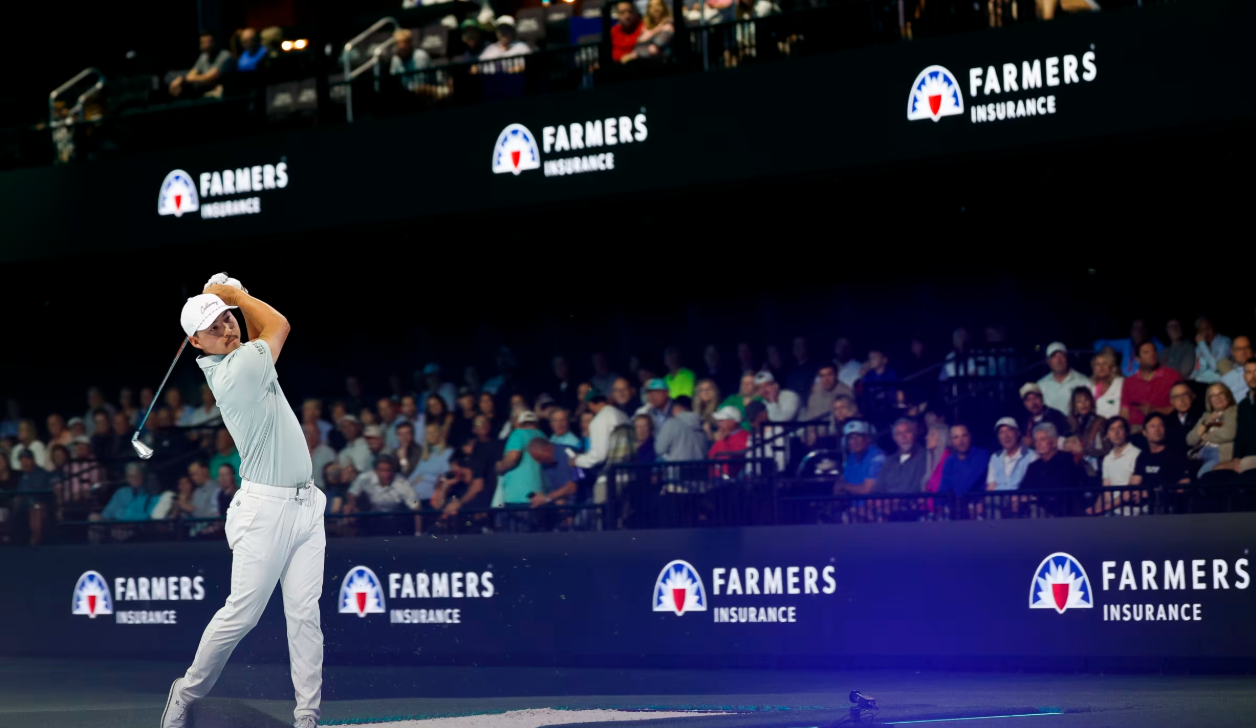
TGL’s first season was still a learning experience for everyone involved. Players were figuring out the format, teams were learning how to use the Hammer, and fans were getting used to watching professional golf in a completely different setting.
But it didn’t take long for memorable moments to pile up.
One of the most talked-about shots came from Kevin Kisner, who managed to blade a shot into the pin. There were also plenty of big drives, including 360-yard bombs from Wyndham Clark, Ludvig Åberg, and Cameron Young. Min Woo Lee reached a top ball speed of 193.0 mph during the season.
The matches themselves provided plenty of drama, too. Los Angeles Golf Club erased a 4-0 deficit against New York Golf Club before eventually winning in overtime during the regular season. New York later returned the favor, upsetting top-seeded Los Angeles in the semifinals.
That competitive unpredictability became one of the most enjoyable parts of the first season. A team could be several points behind and still have a chance to turn the match around.
Atlanta Drive wins the first SoFi Cup
The inaugural championship came down to Atlanta Drive GC and New York Golf Club.
Atlanta won the first Finals match 6-5, setting up a second match that would become one of the defining moments of TGL’s first season.
New York jumped out to a 3-0 lead, but Atlanta refused to go away. The team scored four points over the final four holes to complete the comeback and win the match 4-3.
Billy Horschel provided the moment everyone would remember.
With Atlanta fighting for the championship, Horschel drained a 17-foot putt on the 14th hole. The shot helped swing the match in Atlanta’s favor and sent the SoFi Center crowd into a celebration.
Atlanta completed the 2-0 sweep and became the first team to lift the SoFi Cup. For a league that had spent an extra year waiting to launch, it was quite an introduction.
Season Two: TGL Comes Back More Refined
The teams return with something to prove
By the time Season 2 arrived, TGL was no longer an experiment that fans were seeing for the first time.
Players knew the format. Teams had a season of experience with the Hammer and the unusual match-play strategy. Fans also knew what to expect when they walked into SoFi Center or turned on a match.
The second season also brought noticeable changes to the playing environment.
TGL renovated the GreenZone, increasing the putting surface by 38% and adding more hole locations. The league also made the bunkers larger, changed the slopes, improved sightlines, and introduced new team-specific holes.
The virtual side of the game received updates as well, with sharper graphics and new hole designs intended to create more strategic and risk-reward decisions.
The result was a second season that felt familiar but not exactly the same.
More big moments and bigger comebacks
Season 2 quickly delivered moments that would have been difficult to script.
One of the biggest came late in the regular season when Jupiter Link Golf Club faced elimination against The Bay Golf Club.
Jupiter was down three points with only three holes remaining. Then everything changed.
The team went on a 6-0 run to win the match 9-6 and secure its place in the playoffs. The turning point came on the 14th hole when Tom Kim hit a tee shot that spun back into the cup for a hole-in-one. It was the second hole-in-one in TGL history and gave Jupiter a 7-6 lead. Kevin Kisner then sealed the comeback with a birdie on the final hole.
Season 2 also produced an unusual piece of golf history when Justin Rose made the first albatross in TGL history.
Playing for Los Angeles Golf Club, Rose holed out from about 227 yards with a 4-iron on the par -5 Sterling. The shot gave LAGC a major boost in an 8-4 win over Jupiter and became one of the standout shots of the season.
Those moments showed that the format could create the same kind of unexpected drama that makes traditional golf so entertaining, while adding a few possibilities of its own.
Los Angeles Golf Club takes the SoFi Cup
If Season 1 belonged to Atlanta, Season 2 belonged to Los Angeles Golf Club.
LAGC reached the Finals against Jupiter Links Golf Club, setting up a championship matchup between two teams that had taken very different paths through the postseason.
Los Angeles won the first Finals match 6-5. In Match 2, Jupiter appeared to have the early advantage after taking a 2-0 lead.
Then the match completely changed.
Los Angeles tied the match at the sixth hole and took the lead at the seventh. From there, the team went on a remarkable 9-0 run over five holes. Three straight eagles helped turn the match into a runaway, and Justin Rose finished things off with another eagle in Singles.
LAGC won 9-2 and completed the 2-0 sweep to claim its first SoFi Cup.
It was also a fitting ending for a team that had been the No. 1 seed after the Season 1 regular season but was knocked out in the semifinals. One year later, Los Angeles finished the job.
Two Seasons In, TGL Is Still Evolving
The technology is part of the experience
Technology isn’t simply a backdrop in TGL. It is part of how the competition works.
The ScreenZone allows players to hit full golf shots into virtual environments, while the GreenZone brings the short game into a physical space. The combination lets players compete on holes that would be impossible to build inside a traditional golf venue.
That also gives TGL room to experiment.
In Season 2, the league introduced new virtual holes, improved graphics, and team-specific holes. The GreenZone was expanded and redesigned based on data and player feedback from the first season.
The broadcast experience evolved, too, with new camera angles, shot tracing, augmented-reality graphics, and shot-comparison features added for Season 2.
The players are part of the show
Another difference is how much of the players’ personalities fans get to see.
TGL matches are played in an arena environment, with players interacting with teammates, reacting to shots, and communicating during the match. The team format also gives fans another reason to follow players beyond their individual performances.
That creates a different atmosphere from watching a traditional PGA TOUR event.
Instead of following one golfer around a course for four days, fans get a faster team competition where momentum can change in a matter of minutes.
The league is still changing
Perhaps the biggest takeaway from the first two seasons is that TGL doesn’t appear to be treating its original format as finished.
The league made significant changes between Seasons 1 and 2, using feedback and data from the first season to adjust the GreenZone, virtual holes, graphics, and fan experience.
That’s important for a new sports league.
TGL had already gone through one major reset before it ever played its first match. The 2023 venue incident pushed its launch from 2024 to 2025. Since then, the league has continued to adjust the product based on what players and fans experienced.
Two seasons in, TGL is still finding out what works best.
What’s Next for TGL?
TGL’s first two seasons have given fans a pretty good idea of what the league is trying to create.
Season 1 introduced the concept and produced its first champion in Atlanta Drive. Season 2 built on that foundation, introduced changes to the playing environment, and ended with Los Angeles Golf Club lifting the SoFi Cup.
Along the way, fans have seen dramatic comebacks, clutch putting, huge drives, overtime finishes, a hole-in-one from Tom Kim, an albatross from Justin Rose, and plenty of moments that simply wouldn’t happen in a traditional golf setting.
And that’s really what makes TGL interesting.
It isn’t trying to recreate a PGA TOUR tournament indoors. It’s creating its own version of golf. One that combines professional players, simulator technology, real golf shots, team strategy, and a live sports atmosphere.
TGL may have taken an unexpected extra year to get started, but after two seasons, the league has given golf fans something new to watch and plenty of reasons to keep coming back.
What did you think?
Tap a reaction — no need to write anything.
Thanks for letting us know!
Interested in this?
Leave your details and tell us which applies.

Comments are closed.