
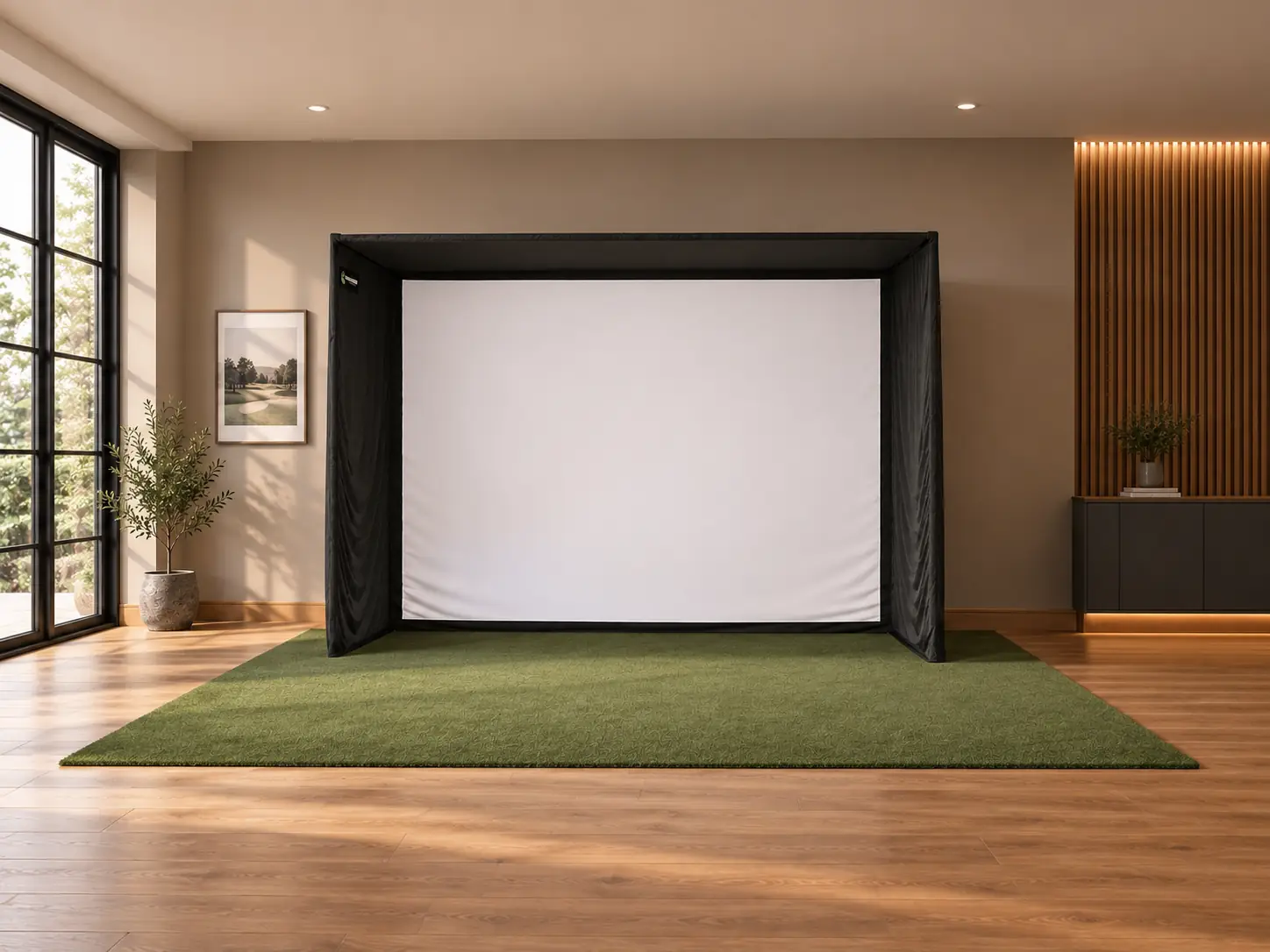
The SIG10 makes sense for a home golfer who wants a matched screen and frame without sourcing and cutting enclosure pipes.
I would put it on the shortlist for a dedicated room with comfortable swing clearance. I would be more cautious in a garage where the car needs the same space every evening.
Its appeal is straightforward assembly and a manageable screen size. The buying mistake is treating the enclosure’s outside dimensions as the dimensions of a finished golf room.
You still need space for the golfer, equipment, screen movement, and anyone watching. Settle those positions before deciding that the SIG10 fits.
Does Your Room Fit More Than the Frame?
The SIG10 measures 10 feet 10 inches wide, 8 feet 4 inches tall, and 5 feet deep. Its assembly guide recommends a room at least 12 feet wide, 18 feet long, and 9 feet high.
Those figures describe different things. The smaller measurements are the structure. The larger ones are the manufacturer’s starting point for using it.
Even the recommended ceiling height isn’t a promise that your driver will clear it. Your height, swing, footwear, and mat all belong in that decision.
I’d check the lowest obstruction above the hitting position, including any garage door track or beam. Measuring to the highest part of the ceiling can give you a misleading answer.
Depth deserves equal attention. Draw the screen, tee position, and back wall on the same plan. Then add the launch monitor in its required position. A room that accommodates the frame can still leave the golfer crowded.
The Screen Shape Should Guide Your Projector Choice
The listed viewable screen is 10 feet 1 inch wide by 7 feet 7 inches high, which is approximately a 4:3 shape. Aspect ratio simply describes the relationship between image width and height.
That shape matters if you’re bringing a widescreen projector into the room. An unchanged widescreen picture won’t automatically cover the entire taller screen without unused space, cropping, or distortion.
The manufacturer’s full-screen-fill description assumes a suitable image setup. I wouldn’t read it as a promise that every projector and computer combination fills the material correctly out of the box.
Before buying, ask the projector supplier to confirm the usable image dimensions and lens position for this screen. Explain which golf software and display settings you intend to use.
If movies are as important as golf, think about how you’ll switch formats. You might happily accept unused screen area for films. That’s a reasonable choice when you’ve planned for it.
Included Poles Are the Main Convenience
The SIG10 includes color-coded push-pin poles, connectors, a SIGPRO Premium impact screen, surround material, foam padding, and ball bungees.
That takes pipe purchasing and cutting off your build list. For someone without suitable tools or transport for long tubing, that convenience has real value.
It doesn’t mean the enclosure arrives assembled. The manual recommends another person and a ladder or step stool, and the fabric still needs to be fitted after the frame is standing.
Lay out the pole colors before standing the frame up, with the final position already marked. The practical advantage is receiving the matching pieces together; you still need working room to connect them and attach the surround.
Foam Padding and Side Nets Do Different Jobs
The included padding covers the frame around the screen. Side barrier netting is identified as an add-on in the assembly guide, so check the order details before assuming it comes with the enclosure.
I would plan protection from the actual hitting position. Look toward the side walls and nearby windows, then consider where a badly struck ball could travel.
A padded screen edge doesn’t extend protection back toward the golfer. If the tee sits behind the front of the enclosure, there may be exposed room surfaces beside that part of the shot path.
With guests, I would review the shot path from both right- and left-handed positions. An enclosure centered against the wall can still leave an exposed side when the golfer changes sides.
Mark Out a Complete Playing Position
A useful SIG10 mockup includes the player’s position and the equipment, not just a rectangle for the enclosure.
I’d put temporary marks on the floor for these checks:
- The screen position and the rear clearance specified for the installation.
- The ball position required by the chosen launch monitor and screen setup.
- The stance area for every handedness that will use the room.
- The nearest obstruction around the golfer’s backswing and follow-through.
Use the intended mat height when evaluating overhead clearance. If you don’t have the mat yet, account for its thickness rather than testing only from the bare floor.
For a shared simulator, a centered picture isn’t enough. Each golfer needs a usable stance without crowding the enclosure or a wall.
If the layout only works when you consciously shorten your normal swing, I’d revisit the room plan. The point of a home bay is to practice comfortably, not spend each session worrying about the ceiling.
What the Listed Price Leaves to Buy
Shop Indoor Golf displayed the SIG10 at $1,999.99 when checked on September 29, 2026. Treat that as a dated enclosure listing, with the exact screen selection and extras confirmed before ordering.
The enclosure isn’t a complete simulator. Plan separate purchases for the launch monitor, projector, hitting mat, compatible computing hardware, software, and any mounting equipment your design requires.
I’d divide the budget into the enclosure, playable equipment, and room work. That makes a missing mount or an unfinished floor easier to notice before you’ve spent the remaining money.
Ask for a delivered enclosure quote separately from any electronics bundle. That makes the value of the included frame easier to judge against a DIY kit with locally purchased tubing.
Screen Tension Matters More Than a Durability Slogan
The included SIGPRO Premium screen uses two polyester faces separated by spacer yarn. That construction is a useful specification, but it doesn’t promise silent impacts or eliminate rebound.
MyGolfSpy’s November 2022 screen test reported favorable noise and bounce behavior after 150,000 shots. It compared screen material, not complete SIG10 installations, so I wouldn’t use it to predict how your room will sound or how many years your screen will last.
The brand’s current screen support recommends 12 to 16 inches behind the material and describes the balance between removing wrinkles and leaving enough give. Pulling everything drum-tight can work against that goal.
Its care guidance also recommends hitting from at least 10 to 12 feet away. Treat those as SIG’s screen recommendations and check them against the launch monitor layout; they aren’t interchangeable with the enclosure’s 5-foot depth.
I’d leave access to the attachments and use clean, unmarked balls and clean clubfaces, as the care guide advises. Those ordinary habits are more useful than assuming premium fabric needs no attention.
When I Would Choose the SIG10
I’d choose the SIG10 when its screen shape suits the projection plan and avoiding pipe sourcing is worth paying for.
The strongest case is a home room where the equipment positions are already settled and the supplied frame removes an unwanted construction task.
I would compare the DIY kit if you’re comfortable measuring and cutting tubing, but only after pricing an equivalent size with its frame materials. The lower initial listing isn’t the finished cost.
If you need a frame designed around overhead electronics or a deeper enclosed bay, investigate the SIGPRO Commercial range separately. Buying the SIG10 first and hoping to adapt it later is a poor substitute for checking those requirements.
For the buyer whose room genuinely suits it, the SIG10 offers a clear route to a permanent screen bay. I’d make the final decision with a measured floor plan beside the order, rather than with the product name alone.
What did you think?
Tap a reaction — no need to write anything.
Thanks for letting us know!
Interested in this?
Leave your details and tell us which applies.

Comments are closed.