
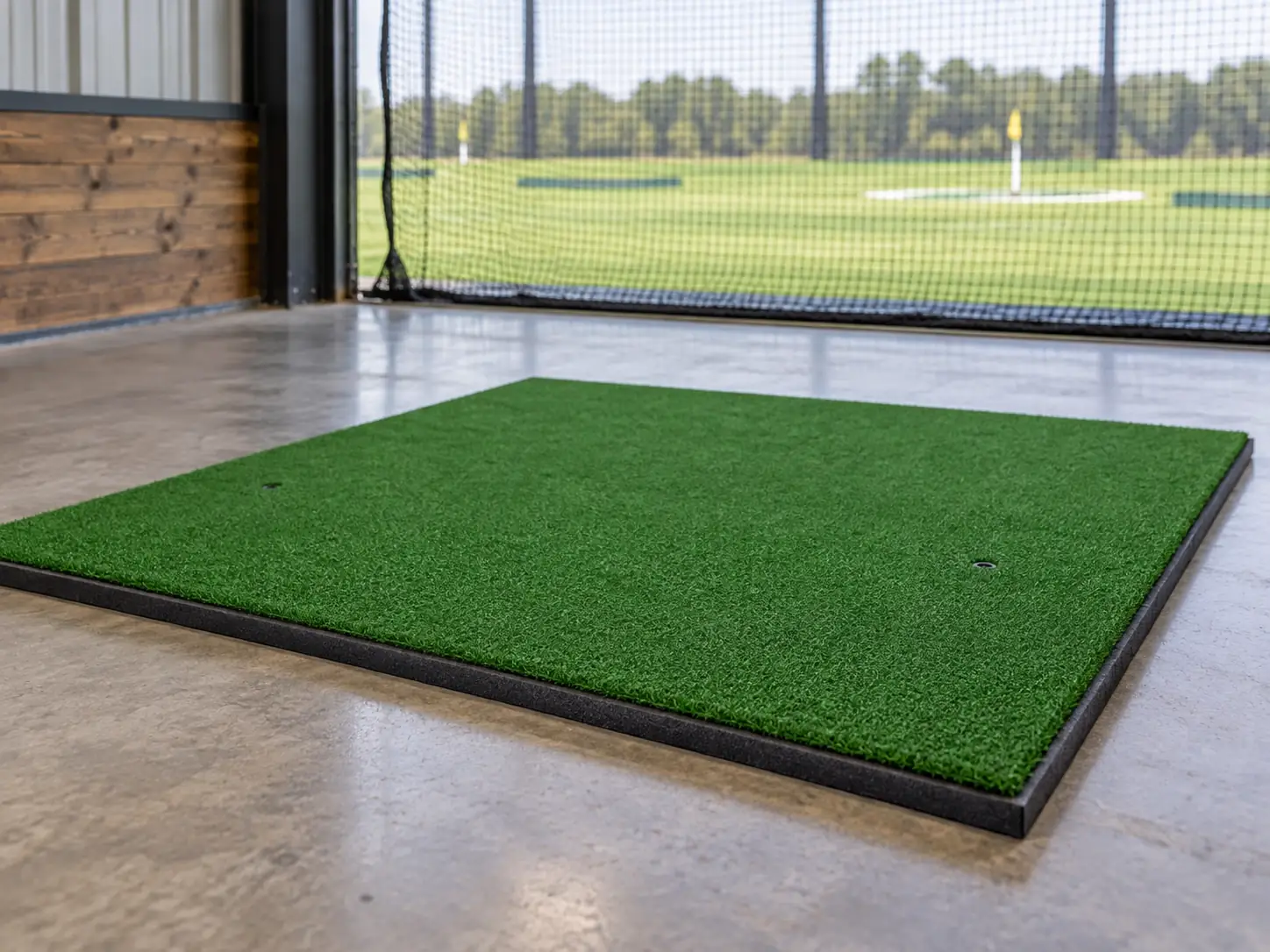
The SIGPRO 3D 5×5 is a straightforward hitting mat for someone who wants a full five-foot-square surface and does not need a replaceable insert in the middle.
SIGPRO markets it for heavy range-style use, and its woven turf, foam, and elastic-fiber construction is different from the modular Softy mats.
I would consider it for a practice station that sees frequent swings and where simple setup matters more than the ability to swap only the strike zone.
The question I would settle first is where you will hit from.
With a one-piece mat, the hitting spot and stance can be adjusted within the surface, but the high-wear area cannot be lifted out and replaced as a separate Softy strip.
Five Feet Square Gives You Options
The SIGPRO 3D product page lists the mat at 60 by 60 inches and about 1.6 inches thick.
The maker’s comparison table rounds the thickness to 1⅝ inches.
That small wording difference is less important than measuring your room from the top of the mat, especially under a low ceiling.
A five-foot-square mat can give a golfer more freedom to adjust stance and ball position than a narrow strip.
It also needs a genuine five-foot floor area, plus space for a safe swing behind and around it.
Measure the ball-to-screen distance from the actual tee position you plan to use, not from the front edge of the mat.
Tee Locations Need a Real Plan
The page describes four tee insert locations.
That can make it easier to choose a ball location without moving the whole mat, but the tee system is not the same as pushing a real tee directly into the Softy Teeline strip.
SIGPRO recommends simulator tees such as BirTee or TeeClaw options for the 3D mat.
Work out your preferred tee height and hardware before judging the convenience of those four holes.
For a permanent bay, I would choose one primary tee location only after the projector, screen, and launch monitor positions are fixed.
Put a ball in each candidate location, then make a full driver swing from both handed stances that matter in your household.
A tee hole can be convenient on paper yet put the ball too near the enclosure side or outside the launch monitor’s best capture area.
Construction Versus Feel
SIGPRO describes woven or knitted turf over elastic fibers and foam.
The idea is to combine a surface built for repeated impacts with some give underneath the club.
It is marketed for commercial or driving-range volume, where a mat has to withstand a lot of swings from different golfers.
Do Not Treat Comfort Claims as Proof
Those are design and intended-use claims, not proof of a particular lifespan or a measured reduction in joint stress.
Public product descriptions do not tell us how many shots a specific golfer will get before the surface changes.
Swing speed, attack angle, shoes, storage, and where the ball is struck all affect wear.
If you are replacing a mat because of wrist or elbow pain, do not assume a new material is a medical fix.
What you can evaluate before buying is the layout.
A continuous surface lets you move the ball within the allowed area, while a replaceable-strip mat keeps the strike zone fixed and makes that zone cheaper to renew.
Golfers who tend to hit from one exact mark may put a lot of wear into a small part of the 3D mat.
Golfers who can use several tee positions may spread that wear more evenly.
This product combines a turf surface and cushioning layers.
A simple category label does not tell you how it will feel with your swing.
The useful comparison is the complete construction, the tee method, and how the mat fits your floor and ball position.
Set the Mat Up With the Launch Monitor
The mat’s roughly 1.6-inch height changes the elevation of the ball.
A ball-side camera launch monitor may specify that its sensor sit level with the hitting surface.
If it is left on bare floor while the ball sits on top of this mat, reads and alignment may suffer.
Check that model’s manual and raise the sensor only in the way its maker allows.
Match Tee Spots to the Sensor
With an overhead monitor, confirm that the intended tee locations fall inside the calibrated hitting zone.
With a radar behind the ball, check the sensor-to-ball line and the mat’s distance from the impact screen.
A good mat cannot make up for a short radar flight path or a screen mounted too close to the wall.
The five-foot width may serve both left- and right-handed stances, but the ball position and launch monitor can still be the constraint.
Before treating the mat as a two-handed solution, tape the ball and both stance areas on the floor and have each golfer make a full swing.
It is much easier to move tape than a finished simulator platform.
What the Full-Surface Design Costs Over Time
Shop Indoor Golf listed the 3D 5×5 at $529.99 on September 16, 2026, well below the Softy 4×10’s listed price.
Part of that difference is size and construction.
The Softy is a wider indoor platform with a replaceable strike insert and real-tee support.
The 3D is a full-surface, range-style mat with separate tee insert positions.
Replacement Economics Matter More Than Claims
The maker’s current SIGPRO limited warranty lists one year for mats under its stated conditions.
That is useful protection against covered defects, but it does not replace a plan for ordinary turf wear.
Since the 3D mat does not list a separate replacement strike strip, consider the cost of replacing or rotating the whole mat over time.
I would choose the 3D 5×5 for a simple, frequently used practice bay where the surface area and lower entry price matter more than modular replacement.
I would choose the Softy if the same indoor ball spot will take thousands of shots and I want to renew just that strip.
Either way, measure the ball position and mat height before ordering.
Those two numbers will affect more of the simulator than the color or texture of the turf.
The choice can be reduced to two questions:
- Choose the 3D 5×5 when several tee spots will see regular use in a range-style station.
- Consider the Softy when most strikes will land on one small area and replacing only that insert would be valuable.
- Mark the planned ball positions on the floor before deciding which surface fits the bay.
That is a replacement-cost decision, not a claim that one surface always feels better under the club.
What did you think?
Tap a reaction — no need to write anything.
Thanks for letting us know!
Interested in this?
Leave your details and tell us which applies.

Comments are closed.