
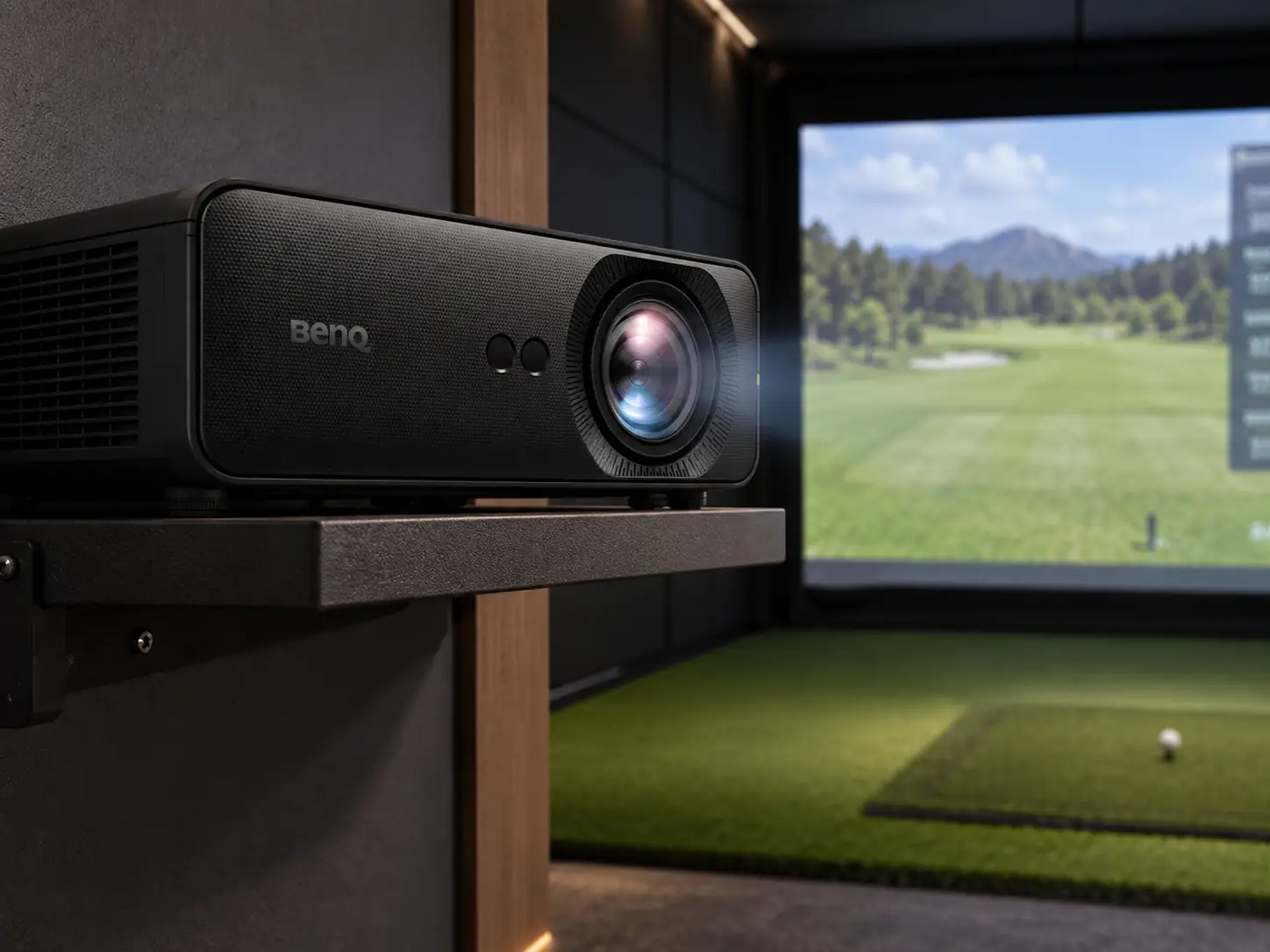
The BenQ AH500ST is a problem solver for a room that cannot give a projector seven or eight feet between lens and screen.
Its roughly 0.5 throw ratio can fill a ten-foot-wide screen from about five feet away, and its 4,000-ANSI-lumen laser has enough output for a serious home bay.
The tradeoff is that the lens is fixed.
You have to be more precise about where the projector goes.
I would consider it for a shallow garage or basement where the projector needs to sit near the screen.
I would be cautious about a floor mount in the path of low shots or rebounds unless it has suitable protection and does not interfere with the golfer.
The Throw Ratio Is the Main Feature
The AH500ST specification page lists a 0.499 throw ratio.
Multiply the intended image width by that number to get a first estimate of lens-to-screen distance.
A ten-foot-wide image starts near five feet.
A twelve-foot-wide image starts near six.
Real installation requires the manufacturer calculator and a check of the exact screen shape and usable borders.
That short distance can put the projector forward of the golfer and reduce the chance of body shadows on the screen.
It can also put the housing closer to where a wedge, high ball, or rebound might go.
A ceiling mount and a protected floor mount have different risks.
Neither should be chosen by looking only at the throw figure.
Short throw moves the projector closer to the screen, which can help with shadows but may expose the housing to more ball and club risk.
For this fixed-lens model, the useful question is whether its short distance still leaves a safe place for the full projector housing.
Fixed Lens Leaves Little Margin
There is no optical zoom range listed.
The spec calls it fixed.
If the image is too wide, moving the projector is the best physical correction.
BenQ’s Screen Fill and digital adjustments can help contain the picture, but shrinking digitally discards some usable resolution.
This is a model where marking the final lens location before drilling or buying a floor enclosure really matters.
For a shallow room, I would map the projector in this order:
- Measure the image width inside the impact screen’s borders, multiply by 0.499 for an initial lens distance, and confirm it with BenQ’s planner.
- Mark the lens, full housing, ball, and golfer on the floor.
- Check swing clearance, high shots, rebound paths, and a protected cable route before choosing the mount.
The fourth step matters as much as the calculation.
A floor projector may clear every club yet sit where a bounced ball can hit it.
A ceiling projector may be protected from that ball and still sit in a driver’s follow-through.
1080p and 4,000 Lumens Are a Useful Pair
The AH500ST displays 1920 × 1080 pixels.
It accepts some 4K source signals, but it does not display a 4K image.
For a golfer standing back from a textured impact screen, a well-set 1080p picture can be more than adequate.
A gaming PC can also run many simulator programs more easily at 1080p than at 4K.
Brightness Is Still Room Dependent
The 4,000-lumen laser gives enough rated light output to keep the course visible with modest room lighting.
It does not make direct sun on the screen harmless.
In a bright garage, window coverings and fixture placement may make the picture look better than a different projector.
The size and gain of the impact screen also change the result.
BenQ lists the laser source at 20,000 hours in normal mode, with a longer Eco rating.
That can reduce the cost and inconvenience of lamp replacement.
It does not determine the whole ownership cost.
A protective floor enclosure, a suitable mount, signal cables, and the PC may all be needed before the room is ready to play.
Pay Attention to Offset and Screen Shape
The AH500ST’s official projection offset is 112%.
In plain terms, the picture is not centered straight ahead of the lens in the same way as a zero-offset installation projector.
That can be useful or awkward depending on whether the unit is on the floor or upside down at the ceiling.
Plan the vertical image position with BenQ’s diagram rather than assuming the lens belongs opposite the screen center.
The projector has two-dimensional keystone and Screen Fill options for several aspect ratios.
Those are useful final controls, especially with a 4:3 or square golf screen.
They cannot change the physical throw.
Nor can they make the beam safe if it crosses a club path.
I would place the projector correctly for the screen first, then use as little digital correction as needed.
Off-Center Mounts Remain Difficult
BenQ does not list lens shift.
A ceiling joist or garage-door track that forces an off-center mount may be a reason to choose another model, even if this is the only one with a short enough throw.
A few inches of physical misalignment are easier to handle than a mount that is far outside the intended geometry.
Is It the Right Compact-Bay Purchase?
Shop Indoor Golf listed the AH500ST at $1,999 on September 16, 2026.
That is less than the AH700ST’s listed price, and the two share a 4,000-lumen 1080p laser approach.
The AH700ST has a longer 0.69–0.83 throw and optical zoom, which may be easier to install when room depth allows it.
The AH500ST earns its place when those extra feet are unavailable.
A Shallow Room Still Needs Monitor Space
Do not forget the launch monitor.
A rear radar unit may need more ball-to-screen and sensor-to-ball space than a shallow room can give, regardless of where the projector fits.
A camera unit beside the ball may solve that part of the room, but you still need a safe swing and screen stand-off.
The projector cannot fix a room that is too short for the rest of the simulator.
I would buy the AH500ST only after plotting the exact lens position, image size, offset, golfer, and protection plan.
In a compact bay where those points line up, it is a useful bright projector.
In a room with more depth, a zoom-equipped model is easier to live with and leaves fewer installation surprises.
One last measurement is easy to miss: the projector housing does not end at the lens.
Leave room behind it for cables and ventilation, particularly if a floor enclosure is being considered.
If the available spot fits the image calculation but not the full unit and cable bend, the fixed lens gives you little optical room to recover.
What did you think?
Tap a reaction — no need to write anything.
Thanks for letting us know!
Interested in this?
Leave your details and tell us which applies.

Comments are closed.